With AI emerging faster than one previously had invisioned, I started to ponder how to use it in service for good. There is no secret that many use it to collect information, discuss deep questions and research various ideas. That said, I, like many others, wish to find the most proficient way to use this tool.
The result of my curiosity promted me to establish a new sub-topic, one that dives deep into my incurable curiosity and throughts that present themselves throughout my day.
I have long thought about the term empathy. With the state of the world one can belive there is a lack thereof.
However I think that it is not something that is learned, it’s a part of the design of the universal design. That being said I will start using this blog to include such thought based on research and philosophy. I am by no means a scientist. Nor will I claim that my reasoning is the basis in terms of said fields. I am not an expert, however, just like many others, I am curious.
Here are my first thoughts, written down, to find answers and reasons, to figure out the answer to the question why.
Proto-Empathy: A Universal Principle of Emergent Cooperative Responsiveness Across Scales
Abstract
Cooperation is a pervasive phenomenon across physical, chemical, biological, and social systems. This paper introduces the concept of proto-empathy—the emergent property of interacting systems in which components adaptively respond to one another to stabilize, coordinate, or optimize the system. Proto-empathy provides a foundational pattern from which conscious empathy in higher organisms emerges. Unlike prior work that treats emergence, cooperation, and empathy separately, proto-empathy unifies these phenomena across scales, forming a continuum from atomic interactions through biological organization to human sociality. This framework offers novel perspectives on the evolution of empathy, the emergence of complex behavior, and the potential universality of cooperative patterns, with implications for complexity science, neuroscience, and philosophy of mind.
1. Introduction
Cooperation is observed in systems ranging from subatomic particles to human societies. In humans, empathy is often considered a learned social trait, yet the underlying capacity for cooperative responsiveness may have deeper, universal roots. This paper proposes proto-empathy as a conceptual framework linking cooperation at all scales to the emergence of conscious empathy. By framing cooperation as an emergent property of interacting systems, proto-empathy provides a unifying lens to examine the continuity of adaptive responsiveness from matter to mind.
Figure 1 (suggested): Continuum of Cooperative Interaction – illustrating matter → life → conscious beings.
2. Definition of Proto-Empathy
Proto-empathy is defined as:
The emergent property of interacting systems in which components adaptively respond to one another to stabilize, coordinate, or optimize the system. Conscious empathy in higher organisms is an evolved, awareness-driven amplification of this foundational pattern.
Key Clarifications:
At lower scales (atoms, molecules, cells), proto-empathy is functional, not conscious or emotional.
It emerges naturally from system interactions, without learning or intentionality.
Conscious empathy in humans and social animals is an amplification of proto-empathy, integrating awareness, cognition, and culture.
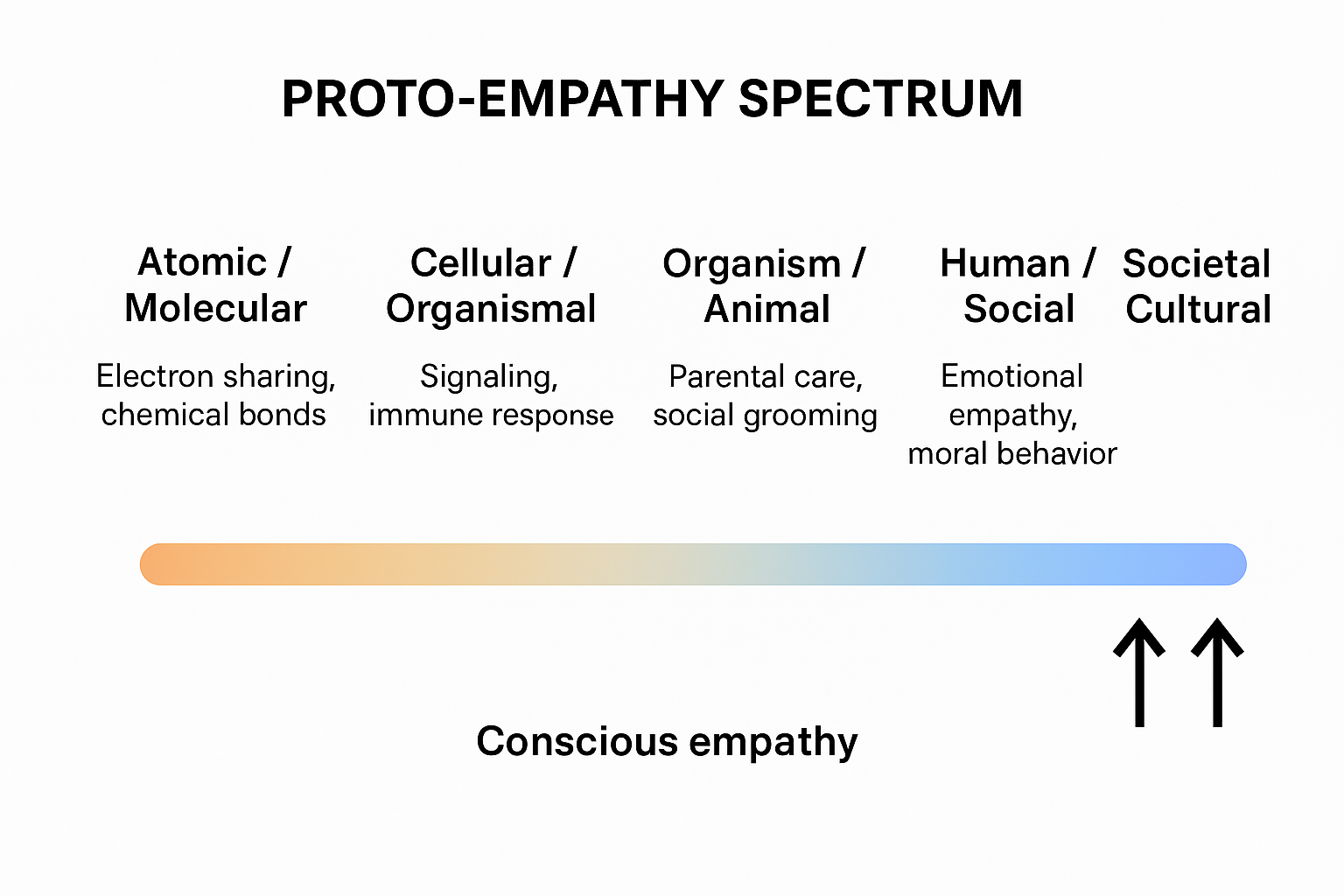
Figure 2:
Proto-Empathy Spectrum – atoms → molecules → cells → humans → societies → speculative cosmic systems.
3. Theoretical Foundations
3.1 Physical / Chemical BasisAtoms and molecules interact according to physical forces, forming stable bonds and self-organizing into complex structures. These interactions are mutually responsive: electrons are shared in bonds, molecules align in self-assembly, and reaction networks stabilize. Functionally, these patterns resemble proto-empathic behavior—components adapt to each other to produce stability.
3.2 Biological BasisCells communicate via chemical signaling, coordinate in response to stress, and engage in cooperative behaviors like symbiosis or quorum sensing. Even unicellular organisms exhibit adaptive responsiveness, forming the biological substrate of proto-empathy.
3.3 Evolutionary / Social BasisAnimals exhibit cooperative behaviors—parental care, social grooming, alliance formation—driven by survival advantages. In humans, these patterns are amplified into conscious empathy through cognition, theory of mind, and cultural norms.
3.4 Philosophical BasisEmergence provides the conceptual bridge: complex adaptive behavior arises naturally from simple interactions. Proto-empathy suggests that empathy is not purely learned, but an evolved manifestation of universal cooperative principles.
4. Proto-Empathy Across Scales
Scale Example MechanismAtomic / Molecular Electron sharing, chemical bonding Mutual stabilization and adaptive interactionCellular / Microbial Signaling, quorum sensing, symbiosis Coordinated response to maintain system integrityOrganismal / Animal Parental care, grooming, cooperation Behavioral responsiveness enhances survival and social cohesionHuman / Cultural Emotional empathy, moral behavior, institutions Conscious amplification of proto-empathic patternsSpeculative / Cosmic Ecosystem self-organization, planetary or interstellar coordination Emergent patterns producing system stability without awareness
Figure 3 (suggested): Scale Mapping of Proto-Empathy – arrows showing emergence into conscious empathy.
5. Testable Predictions and Applications
Nano / Molecular Scale:
Predict emergent cooperative/self-organizing behavior in synthetic chemical systems.
Cellular / Biological Scale:
Observe adaptive signaling networks in single-celled organisms or microbial communities.
Animal / Social Scale:
Examine correlations between interdependence and empathy-like behaviors.
Computational / Simulation Scale:
Agent-based models of proto-empathy should enhance system stability and resilience.Speculative / Cosmic Scale: Explore emergent cooperative patterns in planetary ecosystems or simulations of interstellar civilizations.
6. Addressing Potential Criticisms
Anthropomorphism:
Proto-empathy at lower scales is functional, not emotional.
Falsifiability:
Predictions are grounded in observable or simulated systems.
Speculative Extrapolation:
Cosmic-scale applications are presented as hypothetical extensions, not empirical claims.
7. Implications
Provides a unifying framework for cooperation and empathy across scales.
Bridges physics, chemistry, biology, neuroscience, and philosophy.
Offers insights for astrobiology, artificial life, and complex systems research.
Suggests that cooperation and adaptive responsiveness are universal features of matter and life, not exclusively learned traits.
8. Conclusion
Proto-empathy represents a foundational principle of emergent cooperation across scales. Conscious empathy emerges from this pattern as a high-level amplification integrating awareness and cognition. This framework bridges matter, life, and mind, providing a novel lens for studying cooperation, sociality, and the evolution of empathy.
References
LiteraturePrigogine, I. (1997). The End of Certainty: Time, Chaos, and the New Laws of Nature.
Kauffman, S. (1993). The Origins of Order: Self-Organization and Selection in Evolution.
Nowak, M. A. (2006). Five rules for the evolution of cooperation. Science, 314(5805), 1560–1563.
Axelrod, R. (1984). The Evolution of Cooperation.de
Waal, F. (2006). Primates and Philosophers: How Morality Evolved.
Goff, P. (2019). Galileo’s Error: Foundations for a New Science of Consciousness.
 Anjo Banjo on Gaming Life Love and Art